In the first March edition of Labyrinth, we talk about women in the private security sector with the Secretary General of the Chamber of Private Security, Sanja Kermetchieva. Similar to the state, in the private security sector only 10% of the employees are women. As long as we talk about quotas, as long as we count how many women are in certain positions, regardless of whether it is in the highest state positions, whether it is a position of women managers, whether they are in rectors, in dean's
administrations and so on, in any which position or in specific jobs in security, how many women are police officers, how many in private security, how many are soldiers... Until then and while we are talking about this and while there is a need for special conventions, special laws and policies in companies, we are facing with gender inequality.
Analysis of the developments in Europe in the face of military conflicts, economic problems and social post-covid consolidation.
The Ervopeum forum, which was organized by the Institute for European Politics, gave an overview of the current situation with the mechanisms for the rule of law in the EU and the mechanism for the growth of the union, within which the progress of many aspirants on the way to the EU was considered when it comes to governance of law.
Such events have for the overall promotion of the reforms that even more candidates can undertake before the membership, making the forces candidates for implementing reforms with the aim of Europeanizing the social-institutional environment in these countries.
The road to the Union is paved with the successfully implemented reform, but is Macedonia on the road to the EU?
Can Macedonia defeat corruption, which is the main problem of the state when it comes to Europeanization?
How to free the judiciary from the chain of political and business entrapment - Laws are in powers, but how are they implemented?
Watch the new edition of Labyrinth and find out what's next in the battle for EU membership, where Macedonia is on the map and will the right path to integration emerge? Our guest in this issue is Beba Žagar from the Institute for European Politics.
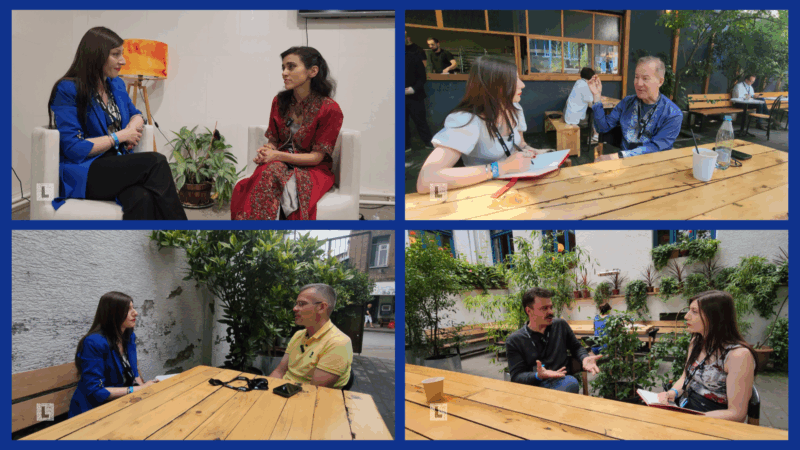
A series of interviews about crisis areas and personal experiences of journalists and humanitarians -
Sееma Jilani, Michael Bociurkiw, Adelin Pertisor and Giorgi Dolidze in this Labyrinth.
This week, Labyrinth in Tbilisi at one of the biggest journalism events - the ZEG Festival. We had the
opportunity to talk to journalists from all over the world about the current situation in their countries.
We present you a series of interviews about the countries that are currently in the global focus.
We spoke with one of the keynote speakers at the event, a doctor who has dedicated her life to treating
children in the most vulnerable places in the world, Seema Jilani. We talked about the great
humanitarian catastrophe unfolding before our eyes, the Gaza Strip, and how we can help people cut off
from all help. Seema also shared her personal experience of what it feels like to treat her own child
injured in an explosion in Beirut.
The war in Ukraine is still raging, and since the coming to power of US President Donald Trump, Russian
attacks on the Ukrainian capital seem to have increased. Meanwhile, in the Middle East, Israel and Iran
are fiercely attacking each other. We talk about the situation in Ukraine and the current hot spots in the
Middle East with Atlantic Council analyst Michael Bociurkiw, who regularly analyzes for CNN and other
global media.
At the event, we also had the opportunity to talk with our colleague Adelin Pertisor from the Romanian
public service, who is one of the most experienced war reporters. He reported on wars in the Middle
East, Africa, as well as the Balkan conflicts and had the opportunity to interview a large number of
leaders, but also some notorious militants such as Željko Ražnjatović - Arkan. Of course, we also talked
about the situation in Romania after the annulled elections when the Constitutional Court recognized
Russian influence in the electoral process.
Since Georgia got a new pro-Russian President who imposed a series of undemocratic laws, Georgians
have been protesting every day. Media freedom and civil society are under attack, and journalists and
citizens are facing prison sentences. We talk to Georgian colleague Giorgi Dolidze about what is
happening in his country.