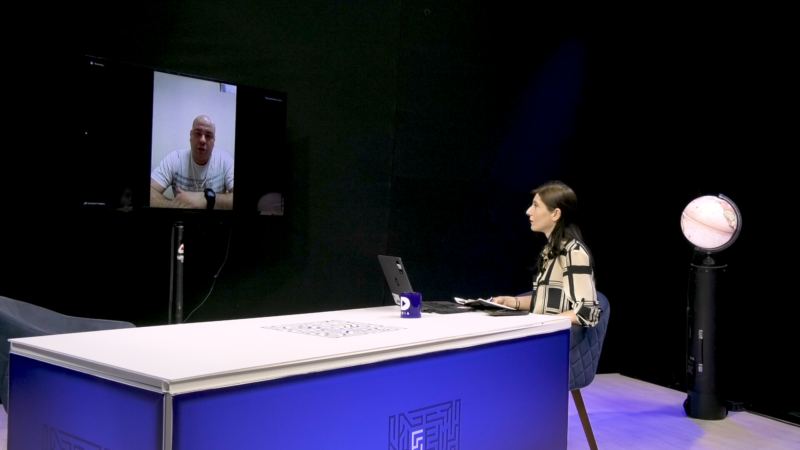
A conversation with the journalist Dimitrova about the situation in Bulgaria and the Macedonian issue.
Bulgaria is facing the seventh parliamentary elections and has been in a political crisis for three years due to the inability to elect a stable government. In the pre-election, Macedonia is even more part of the rhetoric of the political contenders and it seems as if that is the only point on which they agree.
The guest in this edition of Labyrinth is the journalist Tonya Dimitrova from the National Service, with whom we talked not only about the elections, but also about the decisions of the European Court of Human Rights that Bulgaria does not want to implement, the constitutional amendments that they require from us, as well as about the problems that Zaharieva has in her political career towards European institutions.
Watch the full episode.
You Might also like
-
The challenges before the European Union in the post-covid era
Analysis of the developments in Europe in the face of military conflicts, economic problems and social post-covid consolidation.
The Ervopeum forum, which was organized by the Institute for European Politics, gave an overview of the current situation with the mechanisms for the rule of law in the EU and the mechanism for the growth of the union, within which the progress of many aspirants on the way to the EU was considered when it comes to governance of law.
Such events have for the overall promotion of the reforms that even more candidates can undertake before the membership, making the forces candidates for implementing reforms with the aim of Europeanizing the social-institutional environment in these countries.
The road to the Union is paved with the successfully implemented reform, but is Macedonia on the road to the EU?
Can Macedonia defeat corruption, which is the main problem of the state when it comes to Europeanization?
How to free the judiciary from the chain of political and business entrapment - Laws are in powers, but how are they implemented?
Watch the new edition of Labyrinth and find out what's next in the battle for EU membership, where Macedonia is on the map and will the right path to integration emerge? Our guest in this issue is Beba Žagar from the Institute for European Politics.
Post Views: 1,017 -
As long as there are quotas and the need for special laws, we do not have gender equality
Women in the private security sector
In the first March edition of Labyrinth, we talk about women in the private security sector with the Secretary General of the Chamber of Private Security, Sanja Kermetchieva. Similar to the state, in the private security sector only 10% of the employees are women. As long as we talk about quotas, as long as we count how many women are in certain positions, regardless of whether it is in the highest state positions, whether it is a position of women managers, whether they are in rectors, in dean's administrations and so on, in any which position or in specific jobs in security, how many women are police officers, how many in private security, how many are soldiers...
Until then and while we are talking about this and while there is a need for special conventions, special laws and policies in companies, we are facing with gender inequality.Post Views: 1,977 -
Increased efforts to resolve the issues in Kosovo and BiH
Kosovo will enter the Council of Europe, BiH received the green light from the EC